About us

Home / About us

At Education in Crisis (EiC), we believe that learning is a fundamental right and a foundation for dignity, resilience, recovery, and future opportunity. Every child and young person deserves access to safe, inclusive, and meaningful learning opportunities regardless of crisis, displacement, poverty, fragility, or circumstance.

Across many crisis-affected communities, millions of learners continue to face disrupted education systems, exclusion, and limited opportunities to learn and thrive. EiC exists to strengthen resilient learning systems that protect continuity of education and support communities facing instability and disruption.

As a youth-founded organization, EiC recognizes the power of collective action, community leadership, and locally driven solutions in shaping sustainable educational futures. The organization works alongside communities, educators, institutions, partners, and young people to strengthen pathways for learning through accountable, evidence-driven, and resilience-oriented approaches.

EiC believes that protecting education is not only about responding to emergencies — it is about strengthening systems capable of sustaining learning everywhere it is threatened.

Through partnership, advocacy, systems strengthening, and community-centered action, EiC remains committed to advancing resilient and inclusive learning opportunities for crisis-affected communities.

For Learning Everywhere!

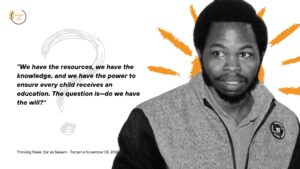
George Omer Nalo

Every child and young person deserves access to safe, inclusive, and meaningful learning opportunities regardless of crisis, displacement, poverty, fragility, or circumstance.

❤ DONATE NOW AND SUPPORT OUR MISSION.

Learn About Us!

Where learning systems, opportunities, access, dignity, or the future of learners are under threat — whether by conflict, displacement, poverty, inequality, disaster, exclusion, institutional failure, or social collapse, Education in Crisis (EiC) is present to act. A distinguished 3-time award winning grassroots NGO present in some of the world’s toughest to reach places where learning is at risk working toprotect, restore, strengthen, and transform learning systems where education is disrupted, threatened, or excluded. Founded in 2019, EiC operates with a commitment to ensuring that learning in Conflict, in Displacement, in Poverty, in Weak systems, in Climate or disaster settings, and in Forgotten communities continues.

EiC Core Areas


1. Education Systems Strengthening

2. Learning Continuity & Resilience

3. Accountability & Community Engagement

4. Research, Evidence & Learning

EiC was first registered in Sudan in 2020 and began its work through its flagship Foundational Scholars Program, supporting crisis-affected communities within the Nuba Mountains and later other conflict-affected areas. However, due to the prolonged armed conflict in Sudan, which significantly affected banking systems, regional coordination, advocacy engagement, and institutional administration, the organization established and registered its coordination office in Arusha, Tanzania with Registration No. 00NGO/R/4348 as a national NGO operating in Mainland.

While the organization’s coordination and institutional registration are based in Tanzania, EiC is present in some of the world’s difficult to reach places including Sudan implementing its programs and partnerships, working closely with communities, local actors, educators, institutions, and partners to support learning continuity and strengthen resilient education systems in crisis-affected contexts.

EiC was established from the recognition that access to education is a priority to empowering individuals with the right tools and skills needed to realize their potentials. Fundamentally, Education represents protection, resilience, dignity, recovery, opportunity, and long-term community transformation. As crises continue to disrupt education systems across fragile contexts, EiC has transitioned into a systems-focused education organization working to strengthen pathways for resilient learning systems capable of adapting to conflict, displacement, fragility, and institutional challenges. The Africa we want is only possible when we ambitiously invest into the quality education for all African children and Youth by 2063 as per the African Union’s agenda for quality human capital.

However, EiC recognizes that meaningful learning cannot happen in isolation. Safe and continuous learning depends on interconnected systems that protect learner wellbeing, participation, access, and resilience. To support learning continuity, EiC integrates enabling approaches including:

Integrated Learning Enablers


  1. WASH in Learning Environments

  2. School Health & Wellbeing

  3. School Feeding & Nutrition Support

  4. Child Protection & Safeguarding

  5. Psychosocial Support & SEL

  6. Community Resilience Structures

Originally founded through youth-led volunteerism and grassroots mobilization, EiC has evolved into a forward-looking organization committed to strengthening resilient learning systems through community-centered, evidence-driven, and accountable approaches. The organization continues to support sustainable educational recovery and long-term systems resilience through locally grounded partnerships and adaptive education solutions.

EiC’s restructuring reflects its transition from primarily emergency education response toward broader institutional engagement in systems strengthening, accountability, resilience, advocacy, and evidence-driven action. This transformation reinforces EiC’s commitment to sustainable, inclusive, and future-oriented learning systems capable of supporting communities affected by crisis and disruption.

EiC believes that wherever learning is threatened, resilient systems and collective action are essential to protect the right to education and future opportunity for all learners.

For Learning Everywhere

Education in Crisis (EiC) was founded from lived experience.

In 2012, as conflict escalated in Sudan’s South Kordofan State, schools across many communities in the Nuba Mountains closed, teachers were displaced, and access to basic services became severely disrupted. Thousands of children saw their education suddenly interrupted.

Among them was a young student who had just completed primary school and was preparing to transition into secondary education. With learning opportunities disappearing and insecurity growing, he left Sudan for Uganda in search of safety and access to education.

Life as a displaced student was filled with uncertainty and hardship. Continuing school required persistence, sacrifice, and support from compassionate individuals who believed education could still create a future despite crisis. Through the support of some well-wishers, secondary education was completed in Uganda in 2018. Yet even after finishing school, financial barriers made university education unattainable and a distant dream.

Instead of allowing that experience to become the end of the journey, it became the beginning of a vision.

In 2019, discussions began with friends and former alumni of St. Vincent Catholic School about creating an initiative that could help learners affected by conflict, poverty and displacement gain access to education opportunities that many had struggled to find themselves. The vision was rooted in one belief:

No child should lose access to learning because of conflict, displacement, or poverty.

The early journey was modest. The founding supporters initially contributed the equivalent of just three dollars per month to help establish the initiative. While many people came and left, 2 friends remained committed to building the foundation of what would later become Education in Crisis (EiC).

In 2022, the initiative evolved into a symbolic “$30 Monthly Support Initiative,” supporting EiC’s flagship intervention: the Foundational Scholars Program. Beginning with two out-of-school girls, the program sought to restore access to education for vulnerable children whose learning had been disrupted by crisis and exclusion.

As support gradually expanded through partnerships and global solidarity, EiC grew beyond a small grassroots effort into a developing humanitarian and education-focused organization supporting children affected by conflict and educational disruption.

Today, as crises continue to disrupt education systems across fragile contexts, EiC has transitioned into a systems-focused education organization working to strengthen pathways for resilient learning systems capable of adapting to conflict, displacement, fragility, and institutional challenges.

The organization has since received recognition and awards across Africa and the United Kingdom in 2022, 2023, and 2025 for its innovation, resilience, and commitment to education in emergencies.

EiC was not created in a boardroom.

It was born from the experience of interrupted learning, displacement, and the belief that education must remain accessible—even in times of crisis.


About the Founder

George Omer Nalo whose lived experience of conflict and displacement inspired the founding  of Education in Crisis (EiC) is a published author of Imagine Being George. His work has been recognized in Africa

Contextual overview of Education in Africa

Education in many pre-colonial African states was in the form of apprenticeship, which was a form of informal education, where children and or younger members of each household mostly learned from older members of their household, and community. In most cases, each household member learned more than one skills in addition to learning the values, socialization, and norms of the community/tribe/household. Some of the common skills that people in precolonial Africa had to learn include, dancing, farming, wine making, cooking (mostly the females), and in some cases selected people learn how to practice herbal medicine, how to carve stools, how to carve masks and other furniture.

The onset of the colonial period in the 19th century marked the beginning of the end for traditional African education as the primary method of instruction. European military forces, missionaries, and colonists all came ready and willing to change existing traditions
to meet their own needs and ambitions.

Since the introduction of formal education to Africa by European colonists, African education, particularly in West and Central Africa, is characterised by both traditional African teachings and European-style schooling systems. The state of education reflects not only the effects of colonialism, but instability resulting from and exacerbated by armed conflicts in many regions of Africa as well as fallout from humanitarian crises such as famine, lack of drinking water, and outbreaks of diseases such as malaria and Ebola, among others. Although the quality of education and the quantity of well-equipped schools and teachers has steadily increased since the onset of the colonial period, there are still numerous inequalities evident in the existing educational systems based on region,
economic status, and gender.

Between the 1950s and 1990s, African countries finally regained their independence. With this recovered freedom, they began to rebuild their traditional forms of education. What had inevitably evolved, however, was a hybrid of the two models. With the collaboration of donor agencies and Western demand, pushes for development of African education and the building of human capital dominated global conversation. Namely, the 1960s were known as the First Development Decade by the UN. Policymakers prioritized secondary and tertiary education before also setting their sights for universal primary education around 1980. This set the precedent for educational planning. Although children and adults may learn from their families and community, a sense of individuality has also developed that today both drives ingenuity and creates separation between groups and cultural tradition.
African education programs have developed that involve both groups; an HIV/AIDS awareness program, for example,
may involve members coming into communities and sharing their knowledge. Although this is a direct, cognitive approach,
they also try to involve all members of the community, allowing for the creation of ownership and cultural acceptance.

SOURCE HERE


Where learning systems, opportunities, access, dignity, or the future of learners are under threat — whether by conflict, displacement, poverty, inequality, disaster, exclusion, institutional failure, or social collapse.

For Learning Everywhere…

In conflict

Education in Crisis means:

  • schools attacked or closed
  • displacement
  • trauma
  • interrupted learning
  • unsafe environments

In displacement

It means:

  • children without continuity
  • temporary learning
  • identity and belonging disrupted
  • exclusion from formal systems

In poverty

It means:

  • children unable to access quality learning
  • education becoming a privilege
  • survival replacing schooling

In weak systems

It means:

  • untrained teachers
  • collapsed governance
  • poor accountability
  • absent infrastructure
  • lack of data and planning

In climate or disaster settings

It means:

  • floods, droughts, epidemics disrupting learning
  • communities repeatedly losing access to education

In forgotten communities

It means:

  • generations still waiting
  • invisibility
  • unequal opportunity
  • systemic neglect